Korean Massage is a form of therapy that has the potential to reach and penetrate nearly every inch of the body, inside and out. Similar to foot or hand reflexology, this method was created in the early 1970s by an established practitioner of acupuncture.
However, unlike acupuncture, this method does not involve needles. Instead, it incorporates the concept of targeting very specific pressure points on the hand that connect to various associated areas on the body, more similar to acupressure.
Similarities are common amongst various forms of massage and physical therapy but Korean Massage, also known as Korean Hand Massage, does differentiate itself from the common hand massages often given at nail salons and typical hand reflexology. Nail salons often include brief hand massage prior to the shaping and painting of nails because it promotes deeper client relaxation. Hand reflexology greatly expands on this, by using the hands as a way to focus on the entire map of the body and its complex systems. Korean Hand Massage takes this one step further, using the complete acupuncture meridian energy system as a guide.
The therapy is performed fully-clothed and can include massage and stimulation of pressure points on the arms as well as hands. Although this massage is used to reduce stiffness, increase mobility, balance hormones, and improve the body’s overall functioning in a very holistic manner, it’s considered one of the top relaxation forms of massage. Because of this, it can often be paired nicely Reiki or other energy work, and Facial Massage.
Its origins come from TCM (Traditional Chinese Medicine) and it is therefore also effective to use in conjunction with herbal teas and tinctures, as well as Aromatherapy Massage. Korean Massage is very useful to people who type on computers 8-9 hours a day, or otherwise use their hands all day long. It’s also an effective treatment for carpal tunnel syndrome. It’s also greatly beneficial for any hand, wrist, and/or arm pains or medical conditions.
Because the hands and feet are believed to carry connections to the entire map of the body, this form of massage is also a quick way to balance out your entire system. A brief glance at any reflexology chart will show the connections of most organs can be accessed via either the feet or hands. Since the hands are typically exceptionally busy throughout the day—whether you are a dishwasher, office worker, or doctor—it makes sense to spend some time pampering and refreshing them.
Original article and pictures take www.massageprocedures.com site
Estimula el metabolismo celular y permite reequilibrar y armonizar el rostro a nivel global
El Kobido tiene sus raíces en la medicina tradicional china, cuyos orígenes se remontan a los tiempos del Emperador Huan Di (2697 – 2597 a.c.). Hacia el año 1300 a.c. los conocimientos de la medicina china llegan a Japón, fue especializándose y adquiriendo características propias. Kobido (en japonés, 古美道, "antiguo camino de la belleza") era un tratamiento reservado únicamente para la familia Imperial, y/o las familias más nobles y adineradas de Japón. Este tipo de masaje pertenece a una rama del Anma, el sistema tradicional de masaje japonés. Se utilizaba en la medicina tradicional, y su método se ha ido perfeccionando durante 200 años.
Anma, literalmente, se traduce como presión más fricción, y era una práctica habitual de los antiguos Samuráis, para restablecer la libre circulación energética en su cuerpo, a través de técnicas de manipulación, manteniendo así el equilibrio físico y mental antes de cada pelea.
La belleza surge del equilibrio entre la salud física, emocional y espiritual, y todas las técnicas que buscan restauran la armonía entre las tres ramas, tendrán un resultado efectivo y duradero. Por ello, no solo hablamos de estética, sino de salud.
Esta técnica de masaje también es conocida por su efecto "lifting", el cuàl se consigue con un tratamiento continuado, y atendiendo a las recomendaciones profesionales que abarcarán no solamente las sesiones de masaje, si no una recomendaciones saludables en cuanto a hábitos de vida.
El Kobido combina técnicas y puntos de Shiatsu
El shiatsu es una antigua terapia de la Medicina Tradicional Japonesa que basa sus beneficios en conseguir la correcta canalización de la energía vital (Chi) mediante la presión, en ciertos puntos clave de nuestro cuerpo, ejercida con los dedos y las palmas de las manos.
Aplicado en el rostro, hace que éste tenga una mayor vitalidad; libera bloqueos energéticos en la musculatura facial y del cuello, relajando las zonas tensionales y reequilibrando el tono muscular, lo cuàl elimina, reduce y previene las arrugas; tiene un efecto global de rejuvenecimiento facial, debido a su acción reparadora del tejido, previniendo y reduciendo el impacto del proceso de envejecimiento. El resultado en la piel es fácilmente visible, aportando luz e hidratación, y eliminando las posibles inflamaciones, como las bolsas bajo los ojos o las secuelas del acné
El kobido mezcla maniobras estimulantes, delicadas, sensitivas, aplicadas de forma sútil, rápida y rítmica sobre la cara, se consigue una gran relajación, similar al que se siente tras un profundo sueño reparador. Es ideal para las personas que viven en ciudades, con alto grado de estrés y contaminación
Estimula el metabolismo celular, lo cual oxigena la piel, porque mejora la circulación de la sangre y el flujo de la linfa, favoreciendo un mayor trofismo tisular y acelerando los procesos de cicatrización, así como la eliminación de toxinas.
Permite reequilibrar y armonizar el rostro a nivel global, modelando los rasgos faciales de ambas hemicaras, con un resultado tensor que favorece la frescura, la luminosidad y en definitiva un rostro sereno y radiante.
La idea es mejorar el flujo del Ki -energía vital- en el rostro para conseguir un bienestar interior completo; un efecto similar a la acupuntura pero sin utilizar agujas. Es el equilibrio de dicho flujo, el que evitará la aparición de la enfermedad y su restablecimiento, ayudará al cuerpo a potenciar su sistema inmunológico.
Estará indicado tanto para hombres como para mujeres; independientemente del tipo de piel, y no tiene ninguna contraindicación. Es tremendamente efectivo en la prevención o mejora de dolores de cabeza, migrañas, dolores faciales, parálisis faciales, bruxismo, cefaleas tensionales, neuralgia del trigémino, sinusitis, y otras dolencias craneo maxilo – faciales.
Kobido es más que un masaje facial, es un masaje completo para tu bienestar: su objetivo era y sigue siendo, dar confort, fuerza, armonía y tranquilidad para mantener inalterado en el tiempo, la propia energía y la belleza, el auténtico secreto de la longevidad.
Original article and pictures take www.wellness-spain.com site
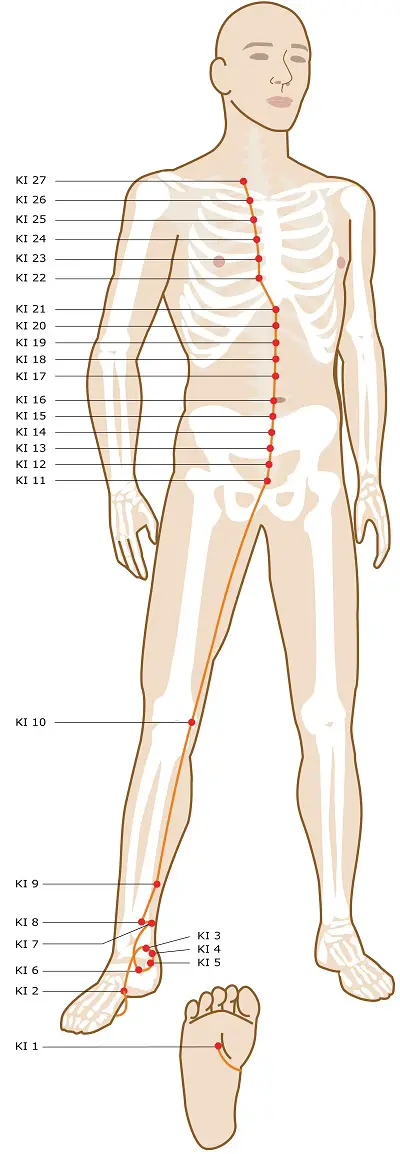
Function: Tonifies yin, clears heat, subdues wind, subdues empty-heat, calms the mind, restores consciousness, clears the brain.
Indications: Headache, blurring of vision, dizziness, sore throat, dryness of tongue, loss of voice, dysuria, infantile convulsions, feverish sensation in the sole, loss of consciousness.
Indications: Pruritus vulvae, prolapse of uterus, irregular menstruation, nocturnal emission, hemoptysis, thirst, diarrhea, swelling and pain of the dorsum of foot, acute infantile omphalitis.
KI 3: tai xi / Great Ravine
Function: Tonifies the Kidneys, benefits essence, strengthens the lower back and knees, regulates the uterus.
Indications: Sore throat, toothache, deafness, tinnitus, dizziness, spitting of blood, asthma, thirst, irregular menstruation, insomnia, nocturnal emission, impotence, frequency of micturition, pain in the lower back.
KI 4: da zhong / Large Goblet
Function: Strengthens the back, lifts the spirit.
Indications: Spitting of blood, asthma, stiffness and pain of the lower back, dysuria, constipation, pain in the heel, dementia.
Indications: Amenorrhea, irregular menstruation, dysmenorrhea, prolapse of uterus, dysuria, blurring of vision.
KI 6: zhao hai / Shining Sea
Function: Nourishes yin, benefits the eyes, calms the mind, invigorates the Yin Motility Vessel, cools the blood, benefits the throat, promotes the function of the uterus, opens the chest, cools heat, calms spirit, benefits throat.
Indications: Irregular menstruation, morbid leukorrhea, prolapse of uterus, pruritus vulvae, asthma, frequency of micturition, urine retention, constipation, epilepsy, insomnia, sore throat.
KI 7: fu liu / Recover Flow
Function: Tonifies the Kidneys, resolves damp, eliminates edema, strengthens the lower back, regulates sweating.
Indications: Edema, abdominal distension, diarrhea, borborygmus, muscular atrophy of the leg, night sweating, spontaneous sweating, febrile diseases without sweating.
KI 8: jiao xin / Intersection Reach
Function: Removes obstructions from the channel, stops abdominal pain, removes masses, regulates menses.
Indications: Irregular menstruation, dysmenorrhea, uterine bleeding, prolapse of uterus, diarrhea, constipation, pain and swelling of testes.
KI 9: zhu bin / Guest House
Function: Calms the mind, tonifies Kidney yin, opens chest, regulates the Yin Linking Vessel.
Indications: Mental disorders, pain in the foot and lower leg, hernia.
KI 10: yin gu / Yin Valley
Function: Expels dampness from the Lower Energizer, tonifies Kidney yin.
Indications: Impotence, hernia, uterine bleeding, dysuria, pain in the knee and popliteal fossa, mental disorders.
KI 11: heng gu / Pubic Bone
Function: Boosts the Stomach and disinhibits damp.
Indications: Fullness and pain of the lower abdomen, dysuria, enuresis, nocturnal emission, impotence, pain of genitalia.
KI 12: da he / Great Manifestation
Function: Supplements Kidney Qi, regulates the Penetrating and Conception vessels.
Indications: Nocturnal emission, impotence, morbid leukorrhea, pain in the external genitalia, prolapse of uterus.
KI 13: di xue / Qi Hole
Function: Tonifies the Kidneys and essence, removes obstructions from the channel.
Function: Fortifies the Spleen and harmonizes the Stomach, regulates Qi dynamic and frees abdominal Qi, regulates the Penetrating and Conception vessels.
Indications: Courses the Liver and rectifies Qi, fortifies the Spleen and harmonizes the Stomach, clears abdominal heat.
KI 22: bu lang / Corridor Walk
Function: Diffuses the Lung and suppresses cough, downbears counterflow and stops vomiting.
Indications: Cough, asthma, distension and fullness in the chest and hypochondriac region, vomiting, anorexia.
KI 23: shen feng / Spirit Seal
Function: Tonifies the Kidneys, calms the mind.
Indications: Cough, asthma, fullness in the chest and hypochondriac region, mastitis.
KI 24: ling xu / Spirit Ruings
Function: Tonifies the Kidneys, calms the mind.
Indications: Cough, asthma, fullness in the chest and hypochondria region, mastitis.
KI 25: shen cang / Spirit Storehouse
Function: Tonifies the Kidneys, calms the mind.
Indications: Cough, asthma, chest pain.
KI 26: yu zhong / Lively Center
Function: Loosens chest and promotes smooth flow of Qi, calms dyspnea and relieves cough.
Indications: Cough, asthma, accumulation of phlegm, fullness in the chest and hypochondriac region.
KI 27: shu fu / Shu Mansion
Function: Stimulates the Kidney function of reception of Qi, subdues rebellious Qi, stops cough, calms asthma, resolves phlegm.
Indications: Cough, asthma, chest pain.
Primary Functions
Influencing the reproductive organs, growth of the body in general and bodily development.
Controlling the production of bone marrow, brain material and fluids, and the health of the bones in general.
Aiding the production of blood cells.
Dominating water and fluids throughout the body.
Controlling the reception of chi energy.
Influencing the health of the ears.
Dominating the anus and urethra.
Common Uses
Aiding in the removal of pathogens from the head.
Treating night sweating.
Treating excessive thirst.
Treating wasting disorder (excessive deterioration of muscle and fat).
Aiding in the treatment of headaches and dizziness caused by Liver meridian energy disruption.
Balancing Kidney fluid levels.
Reducing restlessness, insomnia, poor memory, palpitations, epilepsy, mania, and susceptibility to fright.
Aiding the lungs in the treatment of cough, coughing up blood, dyspnoea (difficult breathing), asthma, wheezing, and other lung-related illness.
Strengthening the kidneys in the treatment of edema (swelling caused by fluid retention), and urinary disorders.
Strengthening Kidney meridian energy to increase sexual libido, and to treat impotence, seminal emission issues, and other sexual disorders.
Strengthening Kidney meridian energy to improve body heat in the lower torso, legs, and feet.
Strengthening the lower spinal area.
Improving the health of the teeth.
Increasing the health of the ears, such as while treating tinnitus and hearing deficiency.
Treating diseases of the uterus such as infertility, menstruation disorders, uterine prolapse, post-partum disorders, and other reproductive problems.
Improving the function of the bladder and intestines to treat difficult urination, retention of urine, painful urinary tract, overly dark or discolored urine, diarrhea, dysentery, hernia, and more.
Treating itching, pain, or swelling of the genitals.
Treating pain of the lower abdominal area.
Removal of constipation caused by dryness or fluid imbalance, related to the kidneys' ability to regulate the body's fluids.
Kidney Meridian Channels & Sinews
The Kidney meridian is the only acupuncture meridian that features a point on the bottom of the foot.
The meridian begins here at acupoint KI1 and travels up the leg, until it reaches near the center of the torso, where it continues up the body until it ends near the collarbone area on the upper chest.
But the Kidney meridian also features several extraneous channels of energy that branch off of it and influence nearby parts of the body.
Let's take a look at the Kidney secondary energy channels.
The Kidney luo-connecting channel
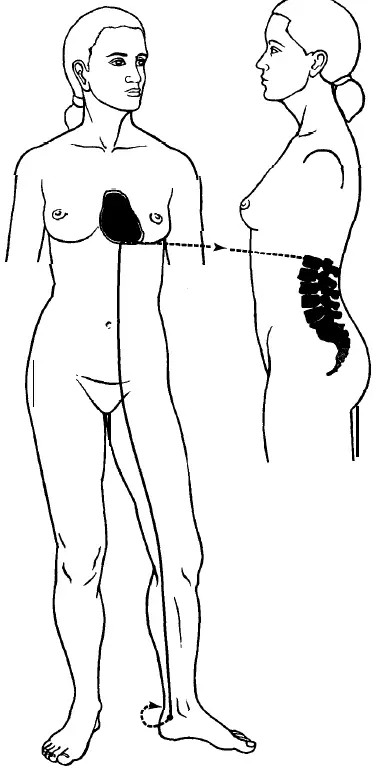
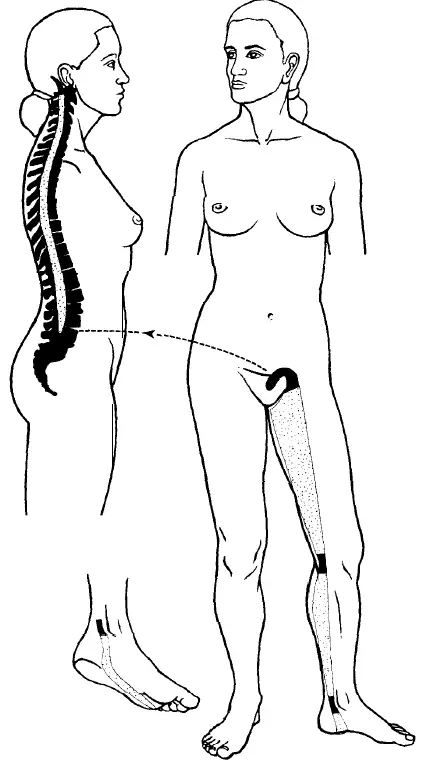
First up we have the Kidney luo-connecting channel, which begins on at acupoint KI4 on the side of the foot.
From the ankle, the luo-connecting channels goes two directions.
Part of it circles behind the ankle and connects with the Bladder meridian near acupoint BL60 on the back of the ankle.
But the main portion of the luo-connecting channel travels up the leg alongside the primary Kidney meridian.
Once it reaches the groin area, it travels up the center of the torso until it hits the center of the chest slightly below the pericardium (the tissue surrounding the heart).
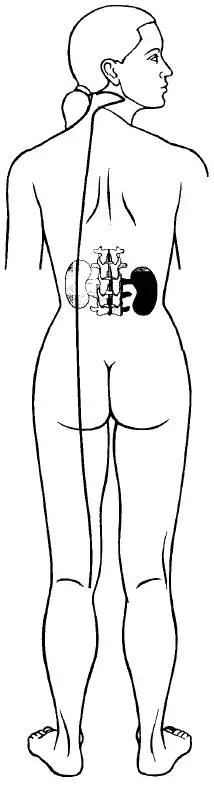
From there, the Kidney luo-connecting channel goes back into the middle back portion of the spine.
The Kidney divergent channel
Next up is the Kidney divergent channel.
This energy pathway appears at the back of the knee area, where it disconnects from the primary Kidney meridian near acupoint KI10.
It travels up the back of the leg, through the buttocks, and up the back all the way until it reaches the neck.
On its way through the leg, it connects with the Bladder divergent channel.
It also passes through the physical kidney in the torso area, as well as the Girdling vessel near the waist.
At the top of the pathway, it reaches inside the neck and passes through the base of the tongue.
From there, it emerges on the back of the neck where it ends by connecting with the primary Bladder meridian near the acupoint BL11.
The Kidney sinew channel
Finally, we have the Kidney sinew channel.
This pathway of muscle and tissue begins beneath the little toe of the foot, near the first primary Kidney meridian acupoint KI1.
At this starting point, the Kidney sinew channel is partially connected to the Spleen sinew channel, which also begins on the foot.
The Kidney sinew channel binds to the ankle bone, then travels up the back side of the leg until it also binds to the knee bone area.
On its way up the upper leg, it partially rejoins with the Spleen sinew channel as it makes its way towards the genitals.
From the genital area, a branch of the Kidney sinew channel separates and traverses internally to the base of the spine, where it then travels up the entire spine.
Near the top of the spine, the Kidney sinew channel ends by converging with the Bladder sinew channel.
Keep Pressing This Point For 2 Minutes! Then See What Will Happen To Your Body!
This point can be very important for you and is located on the webbing between the big and the second toe. What you need to do now is keep pressing this point for about 2 minutes a day. by pressing this point on both of your feet, you are helping in regulation and refreshment of the liver. Stimulating thin point can also help you in treating vision problems, menstrual cramps, headaches, lower back pain, sleeping disorders and insomnia.
This point is located three finger-widths above the inner ankle bone along the back of the tibia. Applying pressure on this point on both of your feet will lead to a proper energy and blood flow throughout your whole body. By stimulating this point you will be able to reduce your knee pain and your lower back pain. Also this point will help you in the treatment of many gynecological problems like PMS, painful or irregular menstruation, insomnia, dizziness and it will also reduce the stress levels.
Very Important Note– This point should not be stimulated during pregnancy.
Ever heard of Ayurvedic medicine? Curious about your dosha? Don’t know what I’m talking about? Read on, my friend, read on!
Ayurvedic medicine is centered on the belief that each person has his or her own unique constitution and that understanding our unique qualities is an essential component of our health and happiness. The idea is that we are comprised of three vital energies (doshas): vata, pitta, and kapha. You may demonstrate one dosha strongly or you may be a combination of two doshas. Your dosha could also change based on a phase in your life. For example, children tend to demonstrate kapha more strongly, pitta in adolescence, and become vata in old age. An undisturbed doshic balance means a happy, healthy person! When sick, understanding what is throwing off your dosha can help you get back to health.
Ayurvedic medicine started in India about 5,000 years ago, but the tradition is recently gaining recognition in western culture. The first step is understanding your dosha, then learning how your body changes in relation to your doshic balance and how to prevent sickness based on the Ayurvedic principles.
I’m borrowing some of the information from a great book called The Book of Ayurveda: A Holistic Approach to Health and Longevity. Here are the basics (and I will say, these descriptions are not particularly flattering!):
“Vata skin is thin, dry, darkish, and cool, and vata hair is thin, dark, coarse, and either kinky or curly. The face is long and angular….the neck is thin and scrawny. The vata nose is small and narrow, may be long, crooked, or asymmetrical. Vata eyes are small, narrow, or sunken, dark brown or gray in color, with a dull luster. The vata mouth is small, with thin, narrow, or tight lips.”
ambition, concentration, confidence, courage, enthusiasm for knowledge, happiness, intelligence
“Pitta skin is fair, soft, lustrous, and warm, and tends to burn easily in the sun. The skin has many freckles, many moles, and a tendency to rashes. Pitta hair is fine and soft, either fair or reddish. The face is heart-shaped, often with a pointed chin. The neck is average and in proportion. The nose is neat, pointed, and average in size. Pitta eyes are average in size, either light blue, light gray, or hazel in color, with an intense luster. The pitta mouth is medium with average lips. Teeth are medium sized and yellowish.”
caring, centeredness, compassion, contentment, faith, fulfillment, groundedness, patience, sense of being nourished, stability, support, tenderness
“Kapha skin is thick, oily, pale, white, and cold. Kapha hair is plentiful, thick, wavy, lustrous, and generally brown. The face is large, rounded, and full. The neck is solid, with a tree-trunk quality. The kapha nose is large and rounded. Kapha eyes are attractive and large, blue or light brown in color. The kapha mouth is large, with big, full lips. Teeth are big and white, set in strong gums.”
kapha pitta vata
Ready to stop guessing which is you? Take this quiz to find out what your dosha is! This is a great time of year to find out your dosha because the seasons are changing, which is a good time to evaluate your health and recalibrate for autumn. Anyone else getting wiped out by a terrible cold? Daggone kapha got me again!
Which one are you??? Firy pitta? Watery kapha? Breezy vata?
Original article and pictures take secure.gravatar.com site
Determining an appropriate Kampo formula requires a sho. Sho is a Kampo diagnosis based on a given patient’s symptoms and patterns of disease.
Sho is far different from Western diagnoses. Patients with the same disease can reflect a different sho and be prescribed different Kampo prescriptions. Conversely, the same Kampo formulas may be used on patients with different diseases, if they reflect the same sho.
Each patient’s sho is determined within the context of an Eastern view of human anatomy and physiology as well as illness. Just like TCM, Kampo uses a unique cognitive paradigm, making extensive use of tools such as:
Yin and Yang,
Exterior and Interior
Cold and Heat
Vacuity (deficiency) and Repletion (excess)
Five organs (heart, lungs, spleen, kidneys, and liver)
In Western nutrition, the individual approach will primarily focus on analyzing the nutritional values of each portion or meal. Kampo and TCM, by contrast, emphasize the characteristics of whole foods, reflecting how they consider that every food has specific thermal characteristics, known as nature and flavour. Foods can be hot, warm, neutral, cool, or cold. Acupuncturists consider these characteristics as elements that will affect an individual’s constitution. The main diagnostic criteria for patients include signs of repletion/vacuity, heat/cold, and dampness/dryness.
For example, a Western nutritionist may recommend a salad containing ingredients like lettuce, tomatoes, and oranges simply as a source of vitamins to a broad range of patients. According to the thermal nature of foods in Kampo and TCM, however, foods such as lettuce, tomatoes, and oranges are considered cold or cool. Thus, the over-consumption of such vegetables and fruits is not recommended for certain group of individuals (e.g., cold/spleen vacuity types). Conversely, if clients are expressing heat constitutional patterns, they may be encouraged to eat those foods that are cold or cool in nature. Ginger provides another interesting contrast. From a Western nutrition analysis point of view, ginger can be seen as simply a source of potassium. In Kampo and TCM, however, ginger is extremely valuable as both an herb and a medicinal food. The warming effect of ginger is highly valuable for patients with a cold constitution, and when combined with other herbs, it is able to enhance the effects of other warming herbs and decrease the undesirable side effects of herbs with cooling natures.
Examples of Thermal Natures of Foods and Beverages
In general, it is considered extremely important that the digestive tract always be kept warm, especially in vacuity- and cold-type individuals. Many people, especially young females, overeat raw vegetable salads and fruits. Eating a large bowl of vegetable salad may be good for replete body types that tend to accumulate heat(typically, individuals with such constitutions tend to develop heart disease, high cholesterol, high blood pressure, diabetes, and stroke). On the other hand, for individuals with other constitutional types, such as vacuity with cold, consuming large amounts of raw vegetables and fruits may not be beneficial. A patient’s constitution can be determined by reviewing his/her health history in conjunction with assessing other physical signs (the pulse, tongue, abdomen, and so on).
The main tenet of the Kampo and TCM diet is concept of balancing the Yin (cold) and the Yang (warm). Traditional East Asian medicine practitioners provide general dietary guidelines based on each patient’s constitutional pattern. For patients with a Yin constitution, it is recommended that they consume more Yang foods and minimize their intake of foods with a Yin nature. For Yang patient the opposite is recommended: their practitioner will recommend that they eat more Yin foods and decrease their intake of foods with a Yang nature. This balance is integral to understanding the Kampo diet.
Call to Arrange Your Nutrition Consultation
Original article and pictures take www.pacificwellness.ca site