Acupressure 101 Relieve Mental & Physical Stress Using These Acupoints
The next time you're feeling tired and stressed out, pull down on your earlobes firmly for a few seconds, or apply firm pressure to the indentation on your nose bridge between your eyebrows using your thumb for several minutes while breathing deeply. Sometimes a little acupressure is all you need to give an extra lift to your mental and physical health.
While there are countless acupressure points (acupoints) from head to toe with very specific points corresponding to different areas of your body and health, you can get started on very basic acupressure 101 to relieve your headache, let go of some stress, give yourself an energy boost, or help with your lower back pain.
Take note that certain acupressure points are not advisable for pregnant women and you should always breathe fully while applying these acupressure points.
Got your own favorite acupressure points? Share with us. (Click on image to enlarge.)
Image via wonderhowto.com Original article and pictures take img.wonderhowto.com site
About Acupuncture Treatment Acupuncture is a safe and effective natural therapy that is used to heal illness, prevent disease and improve well-being.
Acupuncture is a safe and effective natural therapy that is used to heal illness, prevent disease and improve well-being. Tiny, hair-thin needles are inserted into specific points in the body, where they are gently stimulated to trigger the body’s natural healing response. Acupuncture is effective for controlling pain and can regulate the body’s physiological functions to treat various internal dysfunction and disorders.
According to traditional acupuncture theory, there are twelve energy channels called “meridians” running vertically along the length of the human body, each one linking to a specific organ. Illness is caused by obstructed energy flow at certain points along the meridians. Acupuncture therapy stimulates meridian flow and harmonizes the body’s energy to influence the health of both body and mind.
Researchers have begun to examine in Western medical terms the mechanisms by which acupuncture brings about physiological change. Studies have shown that acupuncture influences both the central and peripheral nervous systems. Further evidence indicates that acupuncture stimulates the release of brain chemicals such as endorphins, which function to relieve pain. Research also suggests that acupuncture increases immune system functioning, improves the circulatory system, decreases muscle tightness, and increases joint flexibility. Clinical trials lend credence to these results: acupuncture has been shown to bring about significant improvement for a variety of diseases.
In countries such as Japan and China, which make up about a fifth of the world’s population, acupuncture has been established as a primary form of health care for thousands of years, where the acupuncturist’s role was comparable to that of the physician. Today in such countries, acupuncture treatment remains an integral component of the health care system, offered in conjunction with Western medicine. In North America, acupuncture has drawn growing public attention in recent years. The flood of headlines in the mass media describe this expanding interest and acceptance: The Washington Post, for example, reported in 1994 that an estimated 15 million Americans, or about 6 percent of the population, have tried acupuncture for various ailments that include chronic pain, fatigue, nausea, arthritis, and digestive problems.
In 1995, the US Food and Drug Administration (FDA) reclassified acupuncture needles from the Class III (investigational device) category to the Class II (safe and effective but requiring restrictions) category. In November 1997, the US National Institute of Health held a major conference to discuss the use, efficacy, and safety of acupuncture. Based on their conclusions, the NIH issued a report entitled “Acupuncture: The NIH stated that acupuncture is a useful method for the treatment of a variety of conditions such as post-operative pain, nausea, migraines, arthritis, menstrual cramps, low back pain, and tennis elbow. Furthermore, the NIH acknowledged that the side-effects of acupuncture are considerably less compared with other medical procedures such as drugs and surgery. In addition, the NIH made a recommendation to US insurance companies to provide coverage of acupuncture treatments for certain conditions.
This expanding paradigm is changing the face of medicine as we know it. Acupuncture has already been accepted as one of the more common forms of pain management therapy in many pain clinics in US and Canadian hospitals. As a result, acupuncture is becoming accessible for more and more Canadians. Doctors are recommending acupuncture for their patients for various conditions and insurance plans are beginning to include acupuncture treatments.
Original article and pictures take www.acupuncture-treatment.com site
Todo Yoshimasu is credited for his work in developing Kampo abdominal diagnosis in eighteenth century. The abdominal diagnosis, a practice known as Fukushin is unique to the Kampo School. Although various abdominal diagnoses were originally described in Chinese medical classics such as Shang Han Lun (‘Treatise on Cold Damage’) and Nan Jing (‘Canon of Eighty-One Difficult Issues’), this specific diagnostic method had long been abandoned in China. Thus, this practice is not included in modern iterations of Traditional Chinese Medicine.
Fukushin was further advanced by Bunrei Inaba and Yoshitora (Shukuko) Wakuda by the beginning of the nineteenth century. They have written Fukusho Kiran and Fukusho KiranYoku. The texts are considered as the two most important classics describing Shang Han Lun style abdominal diagnosis.
An Original Cover of Fukusho Kiran (1800)
An Original Cover of Fukusho Kiran Yoku (1809) Fukushokiranyoku F
Illustrations of Classical Fukushin Method (from Fukusho Kiran Yoku, 1809)
Traditional Fukushin Method 1b Traditional Fukushin Method 2b Original article and pictures take kampo.ca site
Menopausal symptoms like hot flashes drive many women to seek natural remedies and medications for relief. Acupuncture and traditional Chinese medicine may offer support for hot flash sufferers. When used in conjunction with usual care methods, acupuncture is a helpful adjunct in relieving menopause-related hot flashes. A practitioner will select certain points based on your symptoms and medical history. Talk to your doctor about acupuncture and menopause, and see a licensed acupuncturist or massage therapist.
Video of the Day
The kidneys, according to Chinese medicine theory, house your essence or jing, which is all the energy with which you are born. Associated with water, these organs help counteract fire and heat from the heart or liver. The kidneys are also associated with your reproduction and growth; as such, during menopause -- when your reproductive capacity is coming to a close -- your kidney energy may be waning. Your acupuncturist may select points to strengthen your kidney energy and help reduce heat associated with hot flashes.
Helpful Kidney Points
Though selection depends on your particular symptoms and conditions, your practitioner may choose to needle kidney point 1, which is located on the sole of the foot. Stimulating this point can promote calm and strengthen kidney energy. Kidney points 3 and 6 may also be selected to strengthen the kidneys and cool hot flashes and night sweats. Kidney 7 may also be useful as it helps regulate sweating and clears heat.
Imbalances in the liver, conception vessel and heart can also, according to Chinese medicine theory, lead to hot flashes and other menopausal symptoms. The liver and gallbladder are linked to female fertility and reproduction as well as anger and frustration. Needling points like liver 2 and 3 can reduce fire and potentially prevent hot flashes. The heart is associated with fire, and the conception vessel can also support hormone and fertility functions. Stimulating heart 7 can also reduce fire and help promote sleep, and heart 6 might reduce sweating associated with hot flashes. Conception vessel point 4 is often used to increase yin, from which cooling fluids are made.
The above-mentioned points can be combined in different ways over the course of a few treatments. Points like stomach 36 can supplement almost any acupuncture treatment, and may be added to your treatment. Stomach 36, according to Peter Deadman's textbook "A Manual of Acupuncture," strengthens overall energy, clears fire, promotes calm and nourishes blood and fluids. For sleep disturbances, the extra point Anmian -- located below the ear -- is helpful. Give your acupuncturist an accurate medical history and symptom list to ensure he can provide you with the best treatment for harmonizing your body.
Original article and pictures take www.livestrong.com site
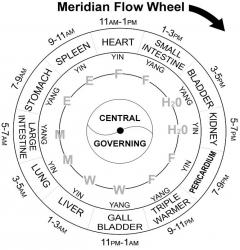
A Guide to the 12 Major Meridians of the Body Meridian Wheel | Source
Meridians of the Body
Meridians of the body are undetectable to the naked eye, and yet we couldn’t live without them. They influence every organ and physiological system in the body. They carry energy throughout the body, much in the same way arteries carry blood. This energy is often referred to as chi, qi, or prana.
Meridians of the body are responsible for all the body’s major organ systems: endocrine, nervous, circulatory, immune, respiratory, skeletal, muscular, digestive, and the lymphatic systems. If the energy flowing through a meridian is imbalanced in any way, the system it fuels is jeopardized and disease results.
Through the flow of energy, meridians bring balance to the body. They remove energetic blocks, excesses and imbalances, regulate metabolism, and support cellular health. Their flow is as important as the flow of blood; your life and health rely on both.
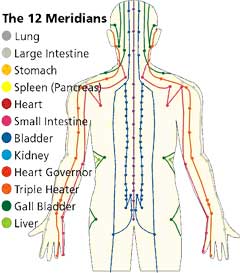
There are 12 major meridians in the body:
Lung
Large intestine
Spleen
Stomach
Heart
Small intestine
Bladder
Kidney
Pericardium (circulation/sex)
Triple Warmer
Liver
Gallbladder
These meridians of the body are in control of not only their corresponding organ, but also additional organs around them. They play a specific and crucial role in the health of the entire system. Energetic imbalances on either side, whether meridians are energy deficient or energy excessive causes problems for the organ systems they regulate. Balance is key in the body and the energy in the meridians is no different.
Meridians of the Body | Source
The 12 Meridians Explained
Lung meridian
The lungs are responsible for both respiration and the intake of energy. If an imbalance in the lung meridian occurs it leaves the body open to viral and bacterial infections, as well as perspiration and inflammation issues in the upper parts of the body, problems with the olfactory organs (nose/sense of smell), and adverse skin conditions.
Large intestine meridian
The large intestine extracts water from waste material and processes it before expelling it. An imbalance of energy in the large intestine meridian is responsible for all abdominal pains. On an emotional level, an imbalance in large intestine energy manifests itself in difficulty with holding on or letting go.
Spleen meridian
The spleen distributes nutrients throughout the body. Because of this it affects muscle and limb tone, controls digestion, and helps regulate the flow of blood within the blood vessels. Energetic imbalances in spleen energy result in: abdominal problems (diarrhea, constipation, bloating), lack of appetite, prolapsed internal organs, weak muscles, and general fatigue. Imbalances in the spleen meridian can also cause brain fog and absentmindedness.
Stomach meridian
All digestive issues can be traced back to the stomach. The stomach’s main responsibility is to digest food, extracting energy from it and distributing that energy to the spleen and intestines. An imbalance in stomach meridian energy can lead to feelings of worry, nervousness, and a lack of acceptance.
Heart meridian
The heart distributes blood to all the organs in the body. An imbalance of energy in the heart meridian results in chest pains, palpitations, shortness of breath, dizziness, hot flashes/cold sweats, irritability and insomnia. A healthy heart meridian allows for joy and bliss in one’s life, while an imbalance can lead to psychological problems like anxiety, depression, and bipolar disorder.
Small intestine meridian
The small intestine is responsible for taking nutrients and energy that it has removed from food and distributing them throughout the body. An imbalance of small intestine energy causes poor circulation, weakness in the legs, always feeling cold, swollen lymph glands, sore/stiff shoulders, acne, nerve pain, poor digestion, and stomach distention.
Bladder meridian
The bladder removes liquid waste from the body. An imbalance in the bladder meridian is responsible for stiffness in the neck and shoulders, headaches, back pains, and all urinary diseases. Emotionally, an imbalance of bladder energy causes feelings of anger and an inability to express emotions.
Kidney meridian
The kidneys store sexual energy. Because of this they also regulate the growth and development of the reproductive system. In addition, the kidneys are also responsible for the production of bone marrow and blood. Therefore, an imbalance in kidney energy causes genital-urinary disorders, as well as backaches, asthma, and tinnitus. On an emotional level the kidney meridian controls willpower, determination, and a person’s ability to cope.
Pericardium (Circulation/Sex) meridian
The pericardium is the area surrounding the heart. The pericardium protects and lubricates the heart and the pericardium meridian removes excess energy from around the heart. This is important because it disperses energy throughout the body preventing the heart from becoming over-energized.
Triple Warmer meridian
The triple warmer controls the body as a whole. Rather than being responsible for a particular organ system, it controls metabolism, heat/moisture balance, and body temperature. Because the triple warmer is responsible for the whole body, an imbalance in triple warmer energy is associated with a wide range of disorders. An issue with any organ in the body is in some way associated to an imbalance in the triple warmer meridian
Liver meridian
The liver stores energy and regulates its flow throughout the body. The liver meridian is also responsible for the female sexual cycle and menstruation and the flexibility of tendons and ligaments. And imbalance of liver energy causes menstrual disorders like PMS, dry skin, jaundice, dry eyes, blurred vision, vertigo, stiff joints, and headaches. On and emotional level, an imbalance of energy in the liver meridian results in anger, irritability, depression, and a lack of control and emotional flexibility.
Gallbladder meridian
The gallbladder is responsible for storing and expelling bile produced by the liver. An imbalance of gallbladder energy causes bloating, liver pains, and a yellow discoloration on the tongue, skin, and in the urine.
What Are Acupuncture Points, or Energy Hot Spots?
Acupuncture points are commonly referred to when talking about meridians. Acupuncture points are “energy hot spots,” or places along the meridian where energy collects, making the chi, qi, or prana more accessible there.
Acupuncture points can be manipulated to increase or decrease the flow of energy in a particular meridian. When energy flowing through the meridians is blocked these points can be accessed to clear blockages. When there is too much energy flowing through a meridian or energy is stagnating in the meridian, acupuncture points can disperse the surplus of energy. Eastern forms of healing, such as acupuncture, acupressure, and Qi Gong are often used to relieve energetic imbalances.
Acupuncture and acupressure are very similar. They use the same points on the meridians in their healing, however, acupuncture accesses these points through needles while acupressure uses the less invasive technique of touch. Qi Gong is another form of Traditional Chinese Medicine. In qi gong meditation, breathwork and gentle movement cleanse and strengthen the meridians and the energy flowing through them.
Acupuncture, acupressure, and qi gong are all forms of what Western medicine calls preventative medicine. This does not mean that these techniques cannot be used as treatments; in fact, these are some the primary forms of treatment used in Eastern medicine. Healings involving the cleansing and balancing of energy flow have begun to gain recognition and popularity in the West, as well.
Qi Gong for Beginners
Original article and pictures take kirstennagy.hubpages.com site
A Debilitated Cat Overcomes the Odds with the Help of Acupuncture
One of my greatest success stories involved a cat that would have never made it without the help of a good Samaritan and a few veterinarians who were willing to give her a second chance.
The good Samaritan found a wounded young cat living as a stray in her neighborhood. The cat exhibited obvious inability to use its hind limbs and appeared to be suffering, so she brought the cat to a hospital facility, at which I was a relief veterinarian for humane euthanasia. After one of my colleagues evaluated this gentle, four pound, intact female Domestic Short Haired (DSH) cat, the decision was made that she would be given a second chance to have a better quality of life.
The cat, who may be known by the name “Pretzel,” or “Toast” (I’ll use Pretzel for this article), had severely compromised function to her hind limbs, causing her to have an abnormal gait and twisted appearance. Pretzel had been likely hit by a car in the months leading up to her presentation for veterinary evaluation. Against remarkable odds, Pretzel survived the dangers of street life by using her normal front limbs to drag around her nearly paralyzed hind limbs. She was also weakened by severe flea infestation, with resulting anemia (low red blood cell count).
Radiographs (X-rays) revealed a fractured pelvis and a lacerated diaphragm (the muscular sheet that separates the chest and abdominal cavity). The tear in her diaphragm displaced a portion of Pretzel’s intestines and liver into her chest cavity, adjacent to her heart and lungs. One of her lung lobes was completely collapsed. The extent of her injuries makes it quite remarkable that Pretzel had survived the trauma and partially recovered.
Surgery was performed to repair Pretzel’s diaphragm and remove her reproductive organs (ovariohysterectomy or spay). Post-surgery, Pretzel showed continued improvement. Although her pelvis had healed with abnormal conformation, she regained sensation and motor function in her previously paralyzed legs through the combination of daily physical rehabilitation and once to twice weekly needle and electrostimulation acupuncture (AP) treatments.
The effects of the electrostimulation were quite profound, as the positive to negative direction of current ran down Pretzel’s spine, through her damaged pelvis, and into her hind limbs, helping to rewire her damaged nervous system. She was so patient and cooperative for her treatments, which required her to stay extremely still so that the acupuncture needles that conducted the electrical impulses stayed firmly in place.
Pretzel’s recovery was also aided by the anti-inflammatory benefits of fish oil based omega 3 fatty acids and chondroprotectants (joint supplements). Additionally, she’s needed to consume a moist food diet to ensure that constipation does not ensue as a result of the reduced diameter of her pelvic canal (through which the colon delivers feces to the outside world).
With time and consistent treatments, Pretzel is walking and moving quite well considering the trauma her petite bones and body incurred. Despite any compromise to her mobility, Pretzel currently moves with a purpose more commonly seen in a fully able bodied cat to her food, litter box, and sleeping quarters.
Pretzel’s progress has been monitored through a series of videos I’ve posted on YouTube:
Have you ever been a good Samaritan who has helped an animal receive care instead of facing a traumatic death, illness, or euthanasia? If so, please tell me about it in the comments section (or just share your perspective on Pretzel’s recovery).
Acupuncture therapy for Pretzel
Pretzel receiving acupuncture therapy
Dr. Patrick Mahaney
Original article and pictures take www.petmd.com site